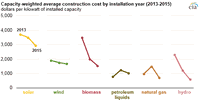
Construction Costs for Most Power Plant Types Have Fallen in Recent Years
Based on EIA survey data for new, utility-scale electric generators (those with a capacity greater than one megawatt), capacity-weighted average construction costs for many generator types have fallen in recent years. Annual changes in construction costs include the effects of differences in the geographic distribution of installed capacity between years, differences in technology types, and other changes in capital and financing costs. EIA began collecting data on construction costs for new...
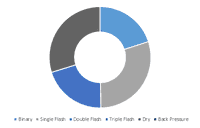
Geothermal Energy Market to Surpass $57 Billion by 2024
Geothermal Energy Market size is set to exceed USD 57 billion by 2024, according to a new research report by Global Market Insights, Inc. Increasing energy demand from heating & cooling systems including ground source heat pump and district heating will positively drive the geothermal energy market. Favorable legislations to reduce GHG emissions will further stimulate demand. The EU has introduced several action plans and framework including Paris Climate agreement and 2030 climate and ene...

Deep Well Services Achieves API Q2 Certification
ZELIENOPLE, Pa. – Deep Well Services (DWS) joined an elite group in the oil and gas industry by attaining the American Petroleum Institute (API) Specification Q2 certification for drilling service providers and the ISO 9001:2015 Quality Management Systems (QMS) certification. API Specification Q2 is the world’s most advanced industry certification standard for oil and natural gas service providers. Fully implemented in 2014, API Specification Q2 was the first ever Quality Management System ce...
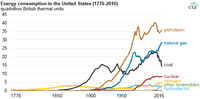
Even as Renewables Increase, Fossil Fuels Continue to Dominate U.S. Energy Mix
Fossil fuels have provided more than 80% of total U.S. energy consumption for more than 100 years. Since 1928, when consumption of natural gas surpassed that of biomass, the three fossil fuels—petroleum, natural gas, and coal—have been the most consumed fuels in the United States. In 2016, fossil fuels accounted for 81% of total U.S. energy consumption, the lowest fossil fuel share in the past century. In 2016, the renewable share of energy consumption in the United States was 10.5%. This was...
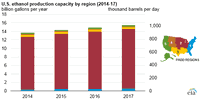
U.S. Ethanol Production Capacity Continues to Increase
Fuel ethanol production capacity in the United States reached 15.5 billion gallons per year, or 1.01 million barrels per day (b/d), at the beginning of 2017, according to EIA's most recent U.S. Fuel Ethanol Plant Production Capacity report. Total capacity of operable ethanol plants increased by about 4%—or by more than 600 million gallons per year—between January 2016 and January 2017. Most of the 198 ethanol plants in the United States, representing most of the U.S. fuel ethanol production c...

PV Solar Panel Field Inspection with UgCS
Solar panel fields, like any other artificial infrastructure objects, require periodical inspections. Usually photovoltaic (PV) solar panel field inspection requires use of two sensors - infrared (IR) and daylight cameras, to detect faulty panels which heat up because of connection issues, physical damage or debris. Drone equipped with thermal camera is the best choice for solar panel field inspection, as in most cases it saves costs compared to manned aviation and saves time compared to visu...

Urban Solar Awarded Contract by City of Tempe for Solar Lighting Installations
BEAVERTON, OR - Urban Solar is pleased to announce the award of a contract to supply solar powered LED lighting systems to the City of Tempe, Arizona. The 5-year contract provides increased safety for Tempe residents and transit users, with reliable solar lighting systems including a stop recognition feature. Tempe City Council passed a master plan in 2015 to enhance safety, quality of life, and technology in its transportation systems, and selected Urban Solar to provide enhanced safety wit...
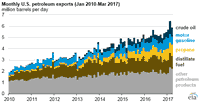
U.S. Exports of Crude Oil and Petroleum Products Have More Than Doubled Since 2010
U.S. crude oil and petroleum product gross exports have more than doubled over the past six years, increasing from 2.4 million barrels per day (b/d) in 2010 to 5.2 million b/d in 2016. Exports of distillate, gasoline, propane, and crude oil have all increased, but at different paces and for different reasons. Restrictions on exporting domestically produced crude oil were lifted in December 2015, and in 2016, the United States exported an average of 520,000 b/d. U.S. crude oil exports reached...

Amec Foster Wheeler Progresses with Transformation Plan as it Completes $170m Sale of CFB boiler Business
As part of the company-wide transformation programme, which includes the sale of non-core assets, Amec Foster Wheeler announces that it has completed the sale of its circulating fluidised bed (CFB) boiler business to Sumitomo Heavy Industries, Ltd (SHI), for a consideration of USD, the net proceeds of which will be used to reduce net debt. The CFB boiler business is the largest part of GPG. The remaining GPG steam generator businesses include the heat recovery steam generator and industrial...
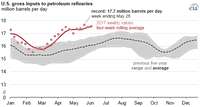
U.S. Refineries are Running at Record-High Levels
Gross inputs to U.S. petroleum refineries, also referred to as refinery runs, averaged a record high 17.7 million barrels per day (b/d) for the week ending May 26, before dropping slightly to 17.5 million b/d for the week ending June 2 and 17.6 million b/d for the week ending June 9. Product supplied to the U.S. market as well as inventories and exports are also at relatively high levels. Weekly U.S. refinery runs have exceeded 17 million b/d only 24 times since EIA began publishing the data...
Stormwater Interview with Robert Page, P.E., Vice President, HNTB

TriMet’s Banfield Type 1 Substation Replacement Project

February Issue 2026