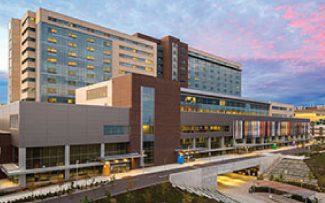
Humber River Hospital and its project partners are pleased to announce the facility’s achievement of LEED® Gold certification through the Canada Green Building Council (CaGBC).
“We designed and built our new hospital on three core principles: Lean, Green and Digital,” notes Humber River Hospital President & CEO Barb Collins. “Being certified LEED® Gold is a testament to the work done by the hospital, and our project partners Plenary Health Care Partnerships and PCL Constructors, in respecting our environment throughout the project, carrying over into the actual building performance. Our design compliance partners HOK also played an important role in helping Humber develop its’ LEED® strategy. We are grateful to the Canada Green Building Council for certifying that this work was done to a very, very high standard.”
One of the most energy efficient acute care hospitals in North America, Humber River Hospital is revolutionizing sustainable healthcare design, with a built environment that is setting the bar for reduction of operating costs and carbon footprint.
“Surpassing the project’s intended LEED® Silver classification to achieve LEED® Gold is a testament to the entire collaborative team’s relentless pursuit of achieving unprecedented energy efficiency targets to reduce Humber River Hospital’s carbon footprint and create a facility that balances energy efficiency and innovative technology, enabling the hospital to focus on its core business of providing exemplary patient care,” says Bruce Macpherson, PCL Constructors Canada Inc. (Toronto) Project Director.
HIGHLIGHTS INCLUDE:
Commissioned building systems which demonstrate unprecedented energy efficiency targets:
o Design energy use intensity (EUI) of 348 ekWh/m2
o 17 points for LEED® Canada-NC 2009 Optimized Energy
o 47% lower than the Energy Star Portfolio Manager Canada target for hospitals
100% fresh air circulation, well above CSA-Z317 standards
20% of materials used to construct the facility contained recycled content and 46% were sourced regionally
96% of construction waste was diverted from landfill
38% of the project’s total site area includes vegetated open space
33% water use reduction and water efficient landscaping using captured rainwater
Vegetated roof and reflective roofing materials to reduce heat island effect
Stormwater Interview with Robert Page, P.E., Vice President, HNTB
TriMet’s Banfield Type 1 Substation Replacement Project

February Issue 2026