In this section, Informed Infrastructure compiles infographics from trusted sources that reveal insight on infrastructure spending. We also compile some of the top infrastructure stories that shouldn’t be missed. For ongoing news coverage, turn to Informed Infrastructure online (https://www.informedinfrastructure.com), our Twitter feed (@IInfrastructure) and our weekly e-newsletter.
Shortage of High-Voltage Lines Threatens U.S. Electrification
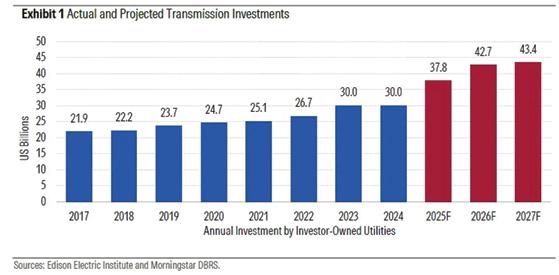
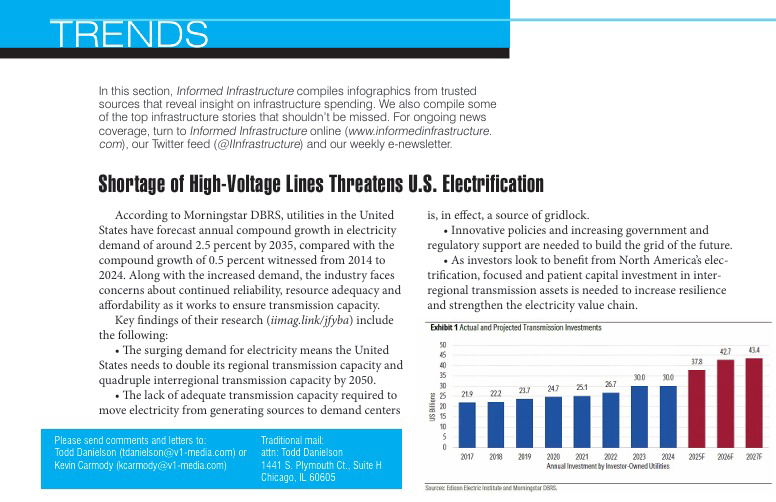
According to Morningstar DBRS, utilities in the United States have forecast annual compound growth in electricity demand of around 2.5 percent by 2035, compared with the compound growth of 0.5 percent witnessed from 2014 to 2024. Along with the increased demand, the industry faces concerns about continued reliability, resource adequacy and affordability as it works to ensure transmission capacity.
Key findings of their research (iimag.link/jfyba) include the following:
• The surging demand for electricity means the United States needs to double its regional transmission capacity and quadruple interregional transmission capacity by 2050.
• The lack of adequate transmission capacity required to move electricity from generating sources to demand centers is, in effect, a source of gridlock.
• Innovative policies and increasing government and regulatory support are needed to build the grid of the future.
• As investors look to benefit from North America’s electrification, focused and patient capital investment in interregional transmission assets is needed to increase resilience and strengthen the electricity value chain.
Research and Analysis Reports Focus on AI in AEC
Multiple reports released at the end of 2025 and beginning of 2026 focused on the most-discussed trend in world technology: artificial intelligence (AI). The following are some examples that relate to the AEC industry:
• Dodge Construction Network, in partnership with CMiC, released “AI for Contractors,” a new research report examining how AI is reshaping the construction industry (https://iimag.link/FLWUJ). The study reveals that 87 percent of contractors believe AI will have a meaningful impact on construction, with many predicting extensive industrywide transformation.
• The rapid global expansion of AI is set to drive a 129-percent increase in water demand across the AI value chain by 2050, according to new research by Xylem and Global Water Intelligence. “Watering the New Economy: Managing the Impacts of the AI Revolution” details how AI is reshaping global water use (https://iimag.link/PrOuh). The report calls for a coordinated “water transition” centered on water reuse, digital infrastructure and cross-sector partnerships to ensure water is a resilient foundation for economic growth, rather than a constraint on innovation.
• The Association for Consultancy and Engineering (ACE) and Autodesk released “AI and the New Era of Engineering Innovation,” a new report revealing how AI is rapidly transforming the UK engineering and consultancy sector, and why urgent, coordinated action is needed (https://iimag.link/oDUub).
Buildings’ Energy Efficiency Remains a Priority
Energy efficiency in facilities and buildings emerged as the No. 1 infrastructure priority for organizations seeking to leverage it for decarbonization and competitiveness, up from 7th place in 2023, finds a recent Siemens survey and study.
According to the “Siemens Infrastructure Transition Monitor 2025,” more than half of survey respondents plan to increase investment in energy efficiency (57 percent), smart building technologies (55 percent) and building electrification (54 percent) in 2026 (https://iimag.link/iXDHo). In addition, a higher proportion of respondents say that onsite renewable energy production and the electrification of heating and cooling now are at mature or advanced stages, compared with previous findings in 2023.
In addition, the International Energy Agency (IEA) “Energy Efficiency 2025” report (https://iimag.link/bspNo) says the world is veering off its pledge to double efficiency gains by 2030, and the authors identify the built sector as one of the main reasons for the slowdown.
The IEA outlines three main areas for improvement: stronger building codes, retrofit investments and digital optimization. However, energy-efficiency experts say these measures must be paired with operational fixes to deliver impact now, not in a decade.
U.S. Renewable Power Capacity to Reach 1.06TW by 2035
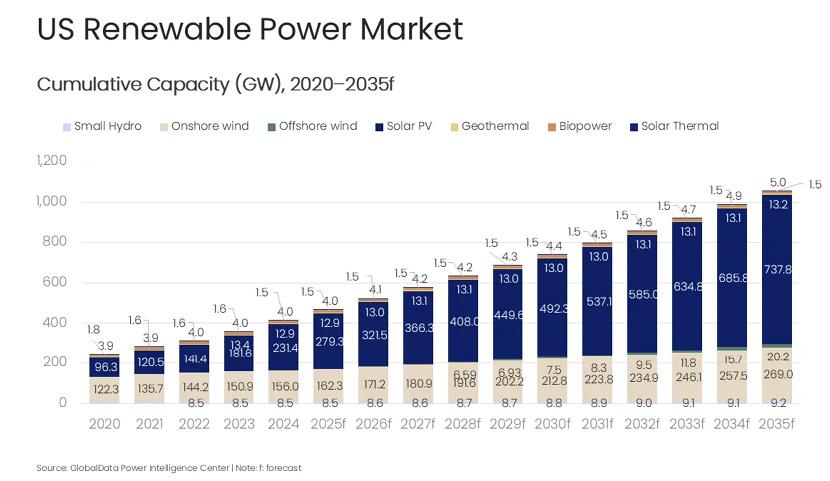
GlobalData’s latest report, “United States Power Market Outlook to 2035: Market Trends, Regulations and Competitive Landscape,” reveals that renewable power capacity growth in the United States is supported by state renewable portfolio standards and clean electricity standards, long-term utility integrated resource plans and sustained corporate power purchase agreement activity from technology, manufacturing and data-center operators.
The report notes that while federal energy policy since 2025 has increasingly emphasized energy security, domestic manufacturing and firm generation capacity, long-term power-sector investment continues to be shaped by state-level clean-energy mandates, utility procurement programs and private-sector demand. Within this framework, renewable energy remains the dominant source of new capacity additions. Against this backdrop, the United States is projected to more than double renewable-energy production to around 1.06TW by 2035 from around 414.5GW in 2024.
The full report can be accessed at iimag.link/emItv.
TOP Stories
The following are the top stories from the last few months (in terms of traffic) on the Informed Infrastructure website. This also reflects key coverage areas that are regularly refreshed online and via our weekly e-newsletter. Simply search key words on Informed Infrastructure online to find the full story.
Buildings
Water
Tools and Technology

Todd Danielson
Todd Danielson has been in trade technology media for more than 20 years, now the editorial director for V1 Media and all of its publications: Informed Infrastructure, Earth Imaging Journal, Sensors & Systems and Asian Surveying & Mapping.
Stormwater Interview with Robert Page, P.E., Vice President, HNTB
TriMet’s Banfield Type 1 Substation Replacement Project

February Issue 2026