About the Deep Tunnel Sewerage System (DTSS)
A superhighway for used water management, the DTSS is a core water infrastructure which provides a cost-effective and sustainable solution to support Singapore’s continued growth and meet its long-term needs for used water collection, treatment, reclamation and disposal.
The DTSS uses deep tunnel sewers to convey used water entirely by gravity to centralised WRPs located at the coastal areas. The used water is then treated and further purified into ultra-clean, high-grade reclaimed water called NEWater, with excess treated effluent discharged to the sea.
DTSS Phase 1, comprising the North and Spur Tunnels, the associated link sewers, the Changi WRP and outfall, was completed in 2008. A NEWater factory, located on the rooftop of the Changi WRP, was built in 2010 to facilitate large-scale water recycling.
The DTSS Phase 2 conveyance system comprises the South Tunnel which conveys domestic used water, the Industrial Tunnel for non-domestic used water and associated link sewers. Expected to complete by 2025, DTSS Phase 2 will extend the deep tunnel system to cover the western part of Singapore, including the downtown area and major upcoming developments such as Tengah Town and Jurong Lake District.
Under DTSS Phase 2, a NEWater factory to be integrated with the Tuas WRP will be built to facilitate water recycling, contributing to the goal of increasing NEWater supply from 40% to up to 55% of total water demand in the long term. Tuas WRP will also be co-located with NEA’s Integrated Waste Management Facility (IWMF), to harness potential synergies.
The completed DTSS will also streamline the used water network with three centralised collection and treatment points: Changi WRP in the east, Kranji WRP in the north and Tuas WRP in the west.
About the Global Water Awards
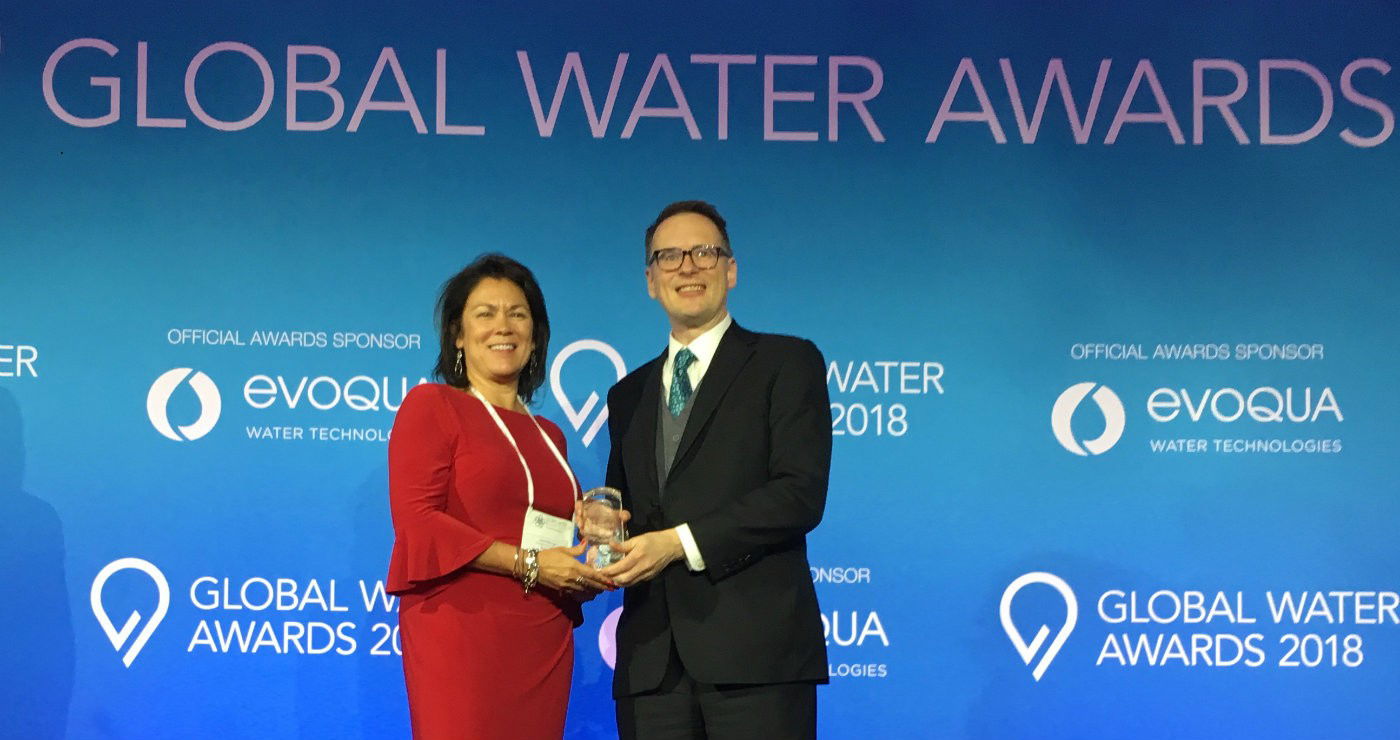
Each year, the coveted Global Water Awards are presented at the Global Water Summit, the major business conference for the water industry worldwide. Established in 2006 by Global Water Intelligence, the awards recognise the most important achievements in the international water industry within several categories, and reward those initiatives in the water, wastewater and desalination sectors that are moving the industry forward through improved operating performance, innovative technology adoption and sustainable financial models. The 2018 Global Water Awards were presented at the opulent Pavillon d’Armenonville in Paris, France on 16 April 2018, as part of the Global Water Summit.
About PUB, Singapore’s National Water Agency
PUB is a statutory board under the Ministry of the Environment and Water Resources. It is the national water agency, and manages Singapore’s water supply, water catchment and used water in an integrated way. PUB has ensured a diversified and sustainable supply of water for Singapore with the Four National Taps (local catchment water, imported water, NEWater, desalinated water). PUB calls on everyone to play a part in conserving water, in keeping our waterways clean, and in caring for Singapore’s precious water resources. If we all do our little bit, there will be enough water for all our needs – for commerce and industry, for living, for life.
About AECOM
AECOM is built to deliver a better world. We design, build, finance and operate infrastructure assets for governments, businesses and organizations in more than 150 countries. As a fully integrated firm, we connect knowledge and experience across our global network of experts to help clients solve their most complex challenges. From high-performance buildings and infrastructure, to resilient communities and environments, to stable and secure nations, our work is transformative, differentiated and vital. A Fortune 500 firm, AECOM had revenue of approximately $18.2 billion during fiscal year 2017. See how we deliver what others can only imagine at
aecom.com and
@AECOM.
[1] Used in the initial stages of wastewater treatment, primary settling tanks separate the solids from liquid wastewater by allowing solids to settle to the bottom of these tanks. The settled solids, also known as sludge, will be removed for biogas generation while the liquid wastewater is then sent for secondary treatment. Lamella primary settling tanks uses inclined plates which increases the maximum efficient surface area for solids to settle on with the same tank space.
[2] MBR technology is used in the treatment of wastewater. A bioreactor houses naturally-occurring bacteria which break down waste products in wastewater, after which microfiltration/ ultrafiltration membranes – with fine pores invisible to the eye – filter the remaining impurities. MBR is a more efficient method as it optimises the wastewater treatment process, enabling wastewater to be treated using less steps and less space compared to conventional systems, and produces a higher quality treated effluent. The treated water is then used as feedwater for NEWater production or supplied to industries.