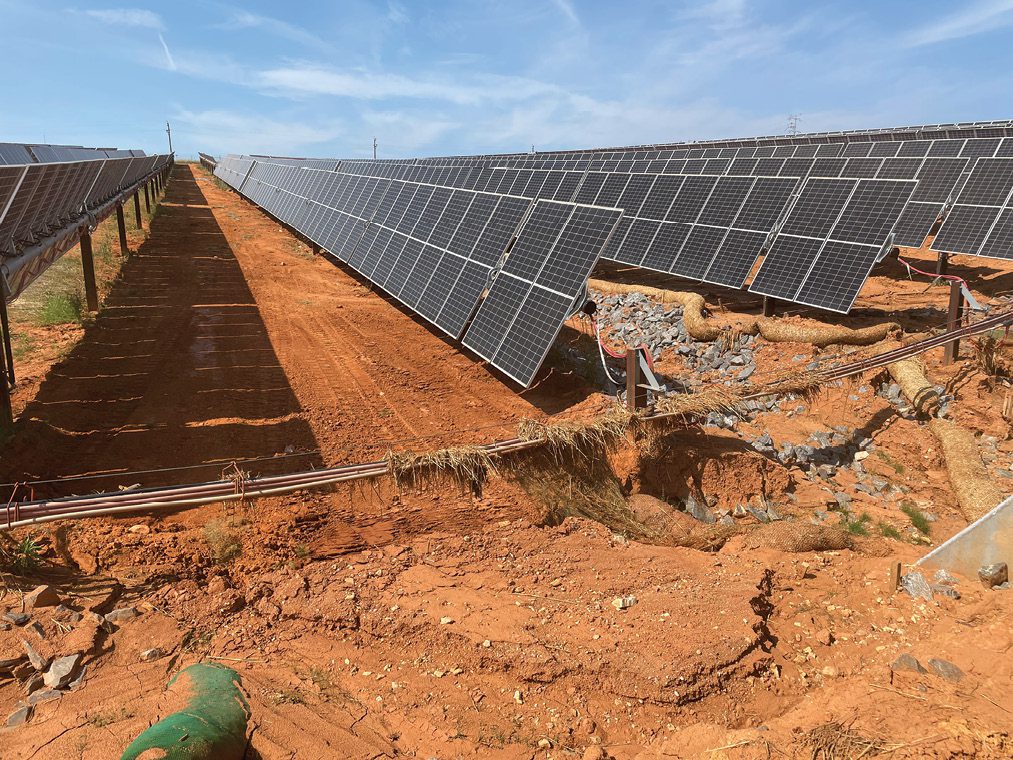
Failure to establish sustainable vegetation on solar sites can cause costly damage to infrastructure.
As the United States accelerates its transition to renewable energy, utility-scale solar projects have emerged as pivotal contributors to meeting clean-energy goals. According to the Solar Energy Industries Association, solar developments have experienced an annual growth rate of 26 percent in the last decade, leading to more than 219 gigawatts (GW) of solar capacity nationwide, which is enough to power more than 37 million homes.
However, alongside this rapid growth, these projects encounter substantial environmental challenges and increasing regulatory influence, particularly concerning the effects of soil erosion during the construction and operation phases. If not addressed early in the planning process, project owners may face expensive fines, risk to infrastructure, further environmental damage and distrust from the community.
Addressing these issues proactively is essential to ensuring not only regulatory compliance, but also the long-term viability and environmental stewardship of solar installations. Through the help of advanced data modeling and fundamental best-management practices, project owners can avoid these costly issues and protect their reputations.
The State of Today’s Solar Sites
In 2024, researchers at Profile Products LLC conducted a study of more than 13,900 current and potential solar project sites nationwide to determine the risk of soil erosion and poor soil health. Using a data-modeling tool called PV-IMPACTS (Integrated Mitigation Program for Assessment of Climate, Topography and Soils), the research evaluated more than a dozen geospatial factors across utility-scale solar sites.
The results showed that nearly 48 percent of solar projects—representing more than 323,000 acres—are classified as at-risk for soil-health issues. Poor soil health can lead to poor vegetation establishment, which increases and perpetuates erosion risks.
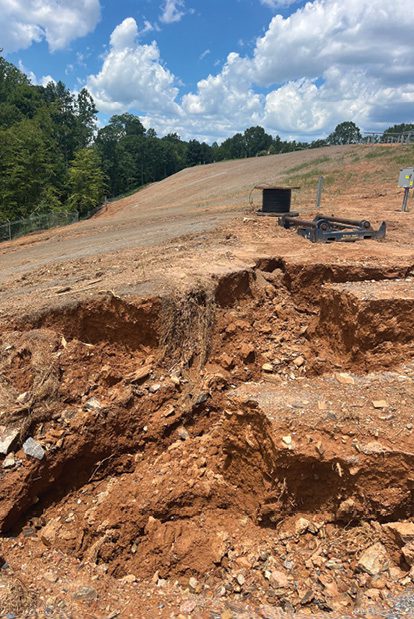
In addition to the soil-health risks, the software found 29 percent of these projects are at-risk for increased erosion. This equates to more than 294,000 acres of land that could experience significant erosion, which can lead to potential stormwater violations and project delays that impact the sustainability of solar projects. As solar installations often require large expanses of land with stable ground for infrastructure, this dual threat of deteriorating soil health and erosion poses a challenge for the industry.
The Risks of Ignoring Erosion Concerns
While on the surface, soil health and erosion may seem insignificant, it doesn’t take long to find news articles about solar sites facing hefty fines for ignoring the warning signs. Developers need to consider the interconnected regulatory, environmental, economic and public-perception risks associated with not proactively addressing soil-health and erosion issues, and work toward the goal of long-term vegetative solutions.
Solar projects are subject to rigorous environmental regulations that mandate sustainable land-management practices. Failure to comply with these standards can result in stop-work orders, increased scrutiny from regulatory agencies and a tarnished reputation within the industry. Proactive soil management ensures that projects meet or exceed regulatory requirements from the outset, thereby avoiding costly compliance issues and fostering a reputation for environmental responsibility. Beyond regulatory fines, erosion-related issues can cause damage to equipment, leading to costly repairs and delays.
Developers need to consider the risk to the environment. Unchecked erosion leads to sediment runoff, which can severely impact nearby waterways. Sediment-laden water degrades aquatic habitats, reducing water quality and harming wildlife. This not only disrupts local ecosystems but undermines the very sustainability goals that solar projects aim to achieve. Many solar-project sites being considered today are plots where previous land use negatively impacts the soil quality and ability to produce sustainable vegetation. The loss of topsoil, which is essential for vegetation growth, can result in long-term soil-fertility decline, making it difficult to establish stable plant cover. If left unmanaged, erosion can lead to significant project delays due to necessary regrading or replanting, driving up costs and potentially impacting the overall project timeline.
Public perception and community support plays a vital role in the success of solar projects, especially in rural or agricultural areas. Visible signs of erosion and land mismanagement can cause mistrust and lead to community resistance against current and future projects. Conversely, demonstrating a commitment to environmental stewardship through effective erosion control can enhance community goodwill and secure local support.
Environmentally savvy developers have an opportunity to further enhance community relations by boosting local agricultural productivity through introduction of native species to build pollinator-friendly habitats around solar sites. Pollinating insects such as bees and butterflies are essential to food production. Establishing such habitats on major solar projects can boost yields for nearby farms, with an estimated annual economic benefit of $63.9 million in increased agricultural productivity.
By proactively addressing soil health and controlling erosion, developers can build goodwill, fostering a positive image as environmentally responsible and community-minded.
The Foundation for a Solution
With the risks identified, it’s important for developers to implement a proactive and prescriptive solution from the outset. A comprehensive land survey is the foundational step in any erosion-control strategy. This includes assessing the above- and below-ground factors to understand the specific challenges of each site.
Above ground, project owners should work with erosion-control contractors and utilize predictive data modeling to learn the topography, estimate how installation of the solar panels may disturb the land or change how stormwater will behave in an area, and identify areas of concern for sediment loss. By identifying any problem areas ahead of time, project owners can be proactive in their solutions and prevent the runoff issues many sites currently face.
Contractors are equipped to conduct thorough soil analyses to understand what’s going on beneath the surface. These tests can measure and identify nutrient deficiencies, pH imbalances and organic-matter content to create a prescriptive solution to amend to optimal levels. By knowing this information ahead of the application, contractors identify and prescribe any soil amendments needed for a more-favorable growth environment.
Employing Best-Management Practices
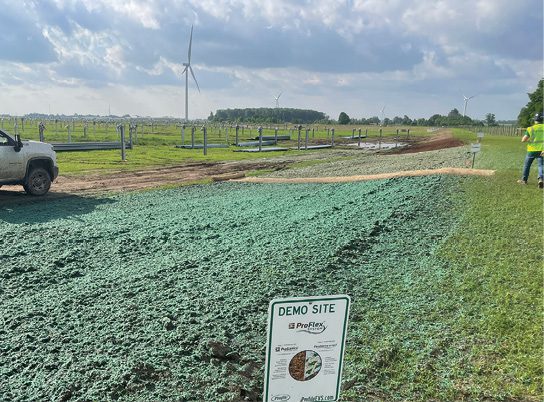
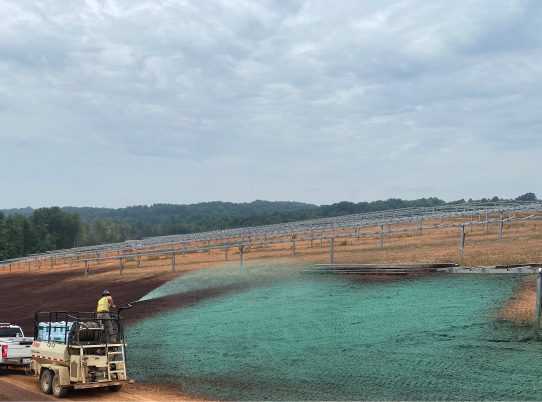
Once project owners have assessed the site, it’s important to then select a solution that will deliver optimal results. Hydroseeding has proven to be an advanced technology that meets the unique challenges that arise when working on these sites. This efficient technique involves applying a slurry of seeds, mulch, water and soil-enhancing technologies over large areas to promote rapid vegetation growth and stabilize the soil.
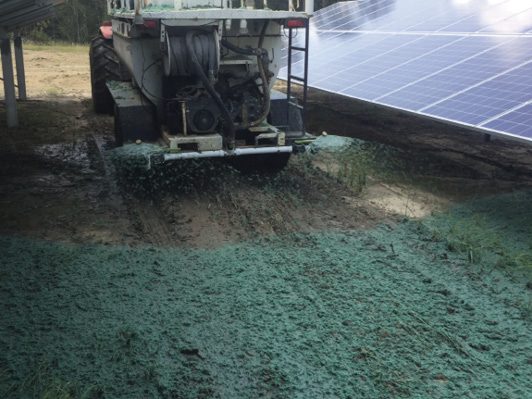
One of the main benefits of hydroseeding is that it accelerates the establishment of vegetation. The rapid growth of plants creates a protective root network that binds the soil, reducing the risk of erosion. The mulch component retains moisture, aiding seed germination and plant survival in arid areas and challenging conditions compared to other temporary erosion-control methodologies.
In most cases, contractors will incorporate the needed supplements that were identified in the soil test into their hydroseeding slurry. Biotic soil media products introduce beneficial microbes and organic matter to the soil to improve long-term nutrient availability, foster root development and promote more-sustainable ecosystem health.
Tactical hydroseeding facilitates the customization of seed mixes tailored to specific site conditions and requirements. Contractors can help project owners choose appropriate plant species that are well-adapted to the local climate and soil, ensuring sustainable growth with minimal maintenance. Installing the agronomic additives, erosion-control products and seed in accordance with the manufacturer’s mixing and application guidelines will maximize their performance to meet project and regulatory requirements.
Compared to traditional erosion-control methods such as sodding or erosion-control blanket installations, hydroseeding reduces labor and material costs while quickly providing extensive coverage across large areas. This efficiency is particularly beneficial for utility-scale projects that span hundreds of acres and require rapid deployment of highly effective erosion-control measures. Moreover, hydroseeding is a nature-friendly solution that doesn’t introduce any plastic, netting or staples into the environment, which can happen with other erosion-control products. This practice eliminates the risk of wildlife entanglement in erosion-control netting and naturally enhances the landscape.
Hydroseeding Case Study: Massachusetts Solar Farm
Many contractors report project success by employing hydroseeding techniques on their solar sites. Because this approach amends the soil itself to build a stronger foundation, hydroseeding often is a long-lasting solution.
A compelling example of effective erosion control and soil-health management is a solar farm project in northern Massachusetts. The project spanned 77 acres, and the local regulating body set a goal of maintaining vegetative cover across 80 percent of the site.
Initial attempts to establish vegetation by simply spreading seed fell short, as no soil test had been conducted beforehand. When the project owner eventually took a soil test, the reason for the failure became evident: the site’s sandy soil had low organic matter—well below the ideal level of 5 percent. This insight guided the development of a targeted strategy using biotic soil media to rebuild organic matter and jumpstart the nutrient cycle. The discussion of site-specific soil conditions sparked discussions about the site’s topography, identifying areas where erosion-control measures were crucial to prevent sediment loss and runoff.
To address these challenges, the contractor applied a mix of hydroseeding products, including biotic soil technologies and erosion-control solutions. Products such as ProGanics Biotic Soil Media, ProGanics DUAL Biotic Soil Media + Erosion Control and Flexterra High-Performance Flexible Growth Medium were used across the site. On steep slopes, the ProFlex System was employed, using a combination of a biotic soil technology (ProGanics) capped with a high-performance flexible growth media erosion-control product (Flexterra) applied at 3,500 pounds per acre, ensuring soil enrichment and robust erosion control. In flatter areas prone to runoff, a biotic soil technology with bonded-fiber matrix-level erosion-control protection (ProGanics DUAL) was applied at 5,500 pounds per acre, delivering soil improvement and protection.
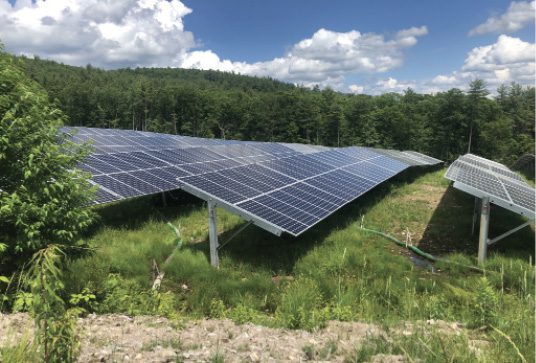
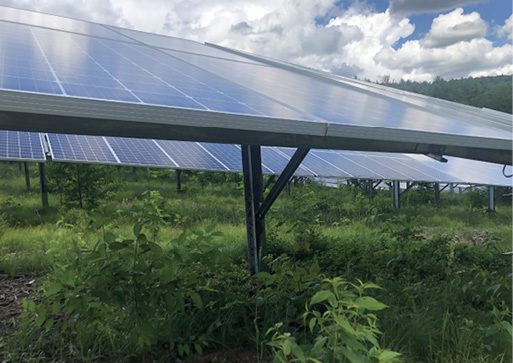
Within a few months of hydroseeding, a northern Massachusetts solar site achieved more than 80 percent grass coverage, meeting the project’s goals.
Within a few months, the results surpassed expectations. The site achieved more than 80 percent grass coverage, meeting the project’s goals with a solid, soil-focused approach. The outcome is a low-maintenance, environmentally sound solution that supports long-term compliance and prevents future environmental issues.
As this example shows, investing in sound soil management and erosion-control measures isn’t merely a regulatory necessity—it’s a strategic imperative that safeguards the future of solar-energy development. Embracing a proactive, prescriptive approach with innovative techniques such as hydroseeding ensures that the solar industry’s expansion contributes positively to energy sustainability and environmental health, paving the way for a greener, more-resilient future.

Ross Bruno
Ross Bruno is the senior marketing manager for Profile Products; email: rbruno@profileproducts.com.
Stormwater Interview with Robert Page, P.E., Vice President, HNTB
TriMet’s Banfield Type 1 Substation Replacement Project

February Issue 2026