
Change Leader: Extensive Planning Leads to More Grants, Better Research
This particular webcam interview was recorded by Todd Danielson, the editorial director of Informed Infrastructure. You can view a video of the full interview above or by visiting bit.ly/3NqR5Dj. Dr. Sarah Orton is an associate professor of civil and environmental engineering at the University of Missouri College of Engineering. Dr. Sarah Orton has been conducting important academic engineering research for more than 20 years. Her specialty is reinforced concrete buil...

Future Forward: Artificial Intelligence Can Transform the AEC Industry
This particular webcam interview was recorded by Todd Danielson, the editorial director of Informed Infrastructure. You can view a video of the full interview above or by visiting bit.ly/3OvDsUP . Mehdi Nourbakhsh, Ph.D., is the CEO of YegaTech, a technology consulting company in the architecture, engineering and construction (AEC) industry. The AEC industry is notorious for being slow to adopt new technology. It’s also prone to a high-risk, low-profit business model. Mehdi...
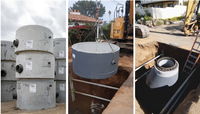
Product Comparison: Precast vs. Cast-in-Place Manhole Base
Photos show precast manholes stacked for deployment (left), being lowered into place (middle) and ready for fill and grading (right). Construction today is all about one word: impact. Low-impact construction is all about designing and producing a sequence and experience that will have the least effect on the existing landscape. That translates into a shorter construction process achieved via the mitigation of labor costs and resulting time savings. High-impact construction, however, can...

Code Update: Change to ACI 318-19 Sets Lower Shear Capacities for Many Concrete Structures
In January 2020, the American Concrete Institute (ACI) published the second printing of ACI 318-19: “Building Code Requirements for Structural Concrete.” ACI 318-19 code sets the minimum criteria for materials, design and detailing of structural concrete buildings and, where applicable, non-building structures. The code is organized into 10 parts: 1. General 2. Loads and Analysis 3. Members 4. Joints, Connections and Anchors 5. Resistance 6. Materials and Durability 7. Strength and Servi...

From the Editor: Will Politics Erode Infrastructure Standards?
My wife and I are planning a road trip from the Midwest to the East Coast. Since we now own an electric vehicle that comes with free charging at certain stations, our road trip will have zero emissions and no fuel costs. Some things are taken for granted when traveling from one place to the next. Some consistency in products and environment is easier to deal with and also convenient. That’s one of the major advantages of commercial chain stores; you pretty much know what to expect from a certai...

ReEngineering the Engineer: Getting Started on the Right Foot(ing)
As a young engineer, starting on a project always seemed daunting. I’d receive plans and elevations (or a 3D model) from the architect or MEP engineers that typically didn’t have much detailed information. I may have been to a couple preliminary meetings discussing the project, but it rarely felt like enough. If the other designers are worth their salt, however, that early information can hold clues to the project’s major elements and help us get started on the right foot. Designs are always e...

Executive Corner: Focus On Three Key Areas to Prepare for the Future
As A&E firms are planning the remainder of 2022 and beyond, it’s critical to be informed on today’s industry trends. As growing pipelines and increased revenue projections increase across the industry, firms are focusing on their people, their technology and how these can work better together. For this installment of “Executive Corner,” Russ Ryan, principal at Rusk O’Brien Gido + Partners (email: rryan@rog-partners.com), interviewed Bret Tushaus, vice president of product management at Deltek (e...

Thoughts From Engineers: The Supreme Court Kicks the Climate ‘Ball’ Back to Congress
Many predicted in the days leading up to the release of the Supreme Court of the United States (SCOTUS) decision in West Virginia v. EPA that something “big” was about to happen. In any other decade, I think the decision would’ve been characterized as “business as usual,” but times are different now. In this particularly tense political climate, stakes are high. The ramifications of this SCOTUS decision in late June 2022 have been widely discussed, and much more analysis will undoubtedly be fort...
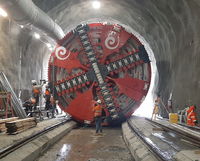
Aligning the Lines: Surveying and Scanning Combine to Build New Zealand’s First Underground Railway
The survey team was instrumental to building the initial 50-m-long tunnel portal for the TBM and then ensuring it stayed on the right path during boring. What often gets lost in the gloss of large construction projects are the small, precise elements that lead to the high-profile finish––the nitty-gritty details surveyors meticulously measure, set out and measure again to ensure buildings are straight, floors are level, tunnels are the right shape, and railway lines are correctly aligne...

Future Proof: Geofoam Pre-Games Construction Challenges as Airports Expand
For Salt Lake City and Denver airports, general contractors Ralph L. Wadsworth and GH Phipps (left and right, respectively) worked with Atlas Molded Products to develop precise configuration plans for geofoam blocks, which were installed by hand during construction. Ask any construction professional about their work and most will say they enjoy that every day is a little different. Even after more than 37 years of hands-on experience, Matt Outsen, who specializes in complex concrete s...
Stormwater Interview with Robert Page, P.E., Vice President, HNTB
TriMet’s Banfield Type 1 Substation Replacement Project

February Issue 2026