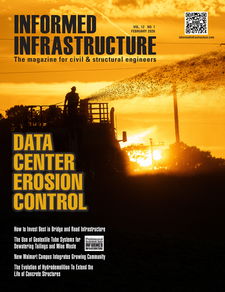
Future Forward: Raise the Roof with More-Sustainable Materials to Bring Down Carbon Emissions
The built environment already is responsible for almost 40 percent of global carbon emissions, according to the UN Environment Programme, and the problem grows larger every day—in fact, the world adds buildings equivalent to the size of Paris every five days. Making a meaningful move toward sustainability requires addressing the whole-life carbon emissions of both new and renovated buildings. Whole-life carbon considers emissions from operating buildings (such as lighting and heating) as well a...
Raising Charleston’s Low Battery Seawall to Stem the Tide of Rising Sea Levels
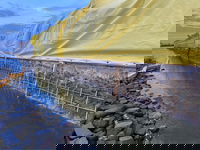
A photo shows in-progress construction to raise the height of the Low Battery seawall in Charleston, S.C., by approximately 2 feet with options to extend the front part of the wall even higher to better accommodate the U.S. Army Corps’ vulnerability study of sea level in the area. A $64 million seawall improvement project in Charleston, S.C., has been designed and constructed to provide a line of defense against rising sea levels. According to the NASA Sea Level Change Portal—which provide...
A Good Neighbor: Treasure Island Looks Toward the Horizon Once Again
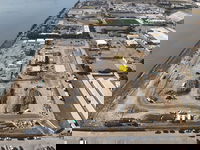
Sitting mid-way between San Francisco and Oakland, Treasure Island promises a return to glory as the Magic City in the bay. To get there, SFPUC sets the stage for success with a state-of-the-art Resource Recovery Facility that rethinks everything from nutrient removal to water recycling. (PCL/Stantec Design Build) Jignesh Desai appreciates clean water, perhaps more than most. He is the senior project manager for the San Francisco Public Utilities Commission (SFPUC) and currently is managing...
Building for Tomorrow: The Crucial Role of Renewable Energy Infrastructure Projects
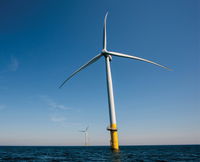
Infrastructure forms the backbone of our society. Yet, as the years pass, infrastructure in the United States has been showing signs of wear and tear. As the world faces economic hardships and the challenges of climate change, it becomes increasingly apparent that we must not only address existing infrastructure issues, but also transition toward sustainable, renewable infrastructure. Skanska is certainly aware of these needs and has dedicated more than 130 years to the cause of infrastructure...
Digital Twins Add Value for Owners Across the Project Lifecycle
Reality-capture technology provides architects and design teams with increased accuracy at the start of a construction project. When discussing the nation’s infrastructure and its need for revitalization, the conversation must focus on the role of technology, which has the power to revolutionize the country’s approach to infrastructure. Against this backdrop, federal agencies are increasingly turning to digital twin models on federally funded projects. Civil and structural engineers must b...

Transportation Troubleshooting: Before Buying Buses: Preparing for a Net Zero Fleet
“We choose to go to the moon in this decade and do the other things, not because they are easy, but because they are hard.” – President John F. Kennedy, Sept. 12, 1962 When President Kennedy famously made this declaration, many detractors scoffed at his ambitious goal as being unrealistic, misguided or unnecessary. But his vision motivated an age of space exploration and innovation that demonstrated what can be achieved when we “organize and measure the best of our energies and skills.” I was...

Infrastructure Outlook: Help Create a Platform for Climate-Resilient Housing and Communities Innovations
As engineers, we’re trained to build structures that withstand external forces. But what happens when climate-change-induced disasters become more frequent and severe? It’s time to expand our capacity and knowledge to tackle new climate changes that are challenging our built environment and humanity. Climate change is reshaping our world with every passing season. The impact is devastating in low- and middle-income countries where the built environment and homes often are most vulnerable. Flood...

Water Works: Making Large-Scale Green Stormwater Infrastructure Possible in Ultra-Urban Areas
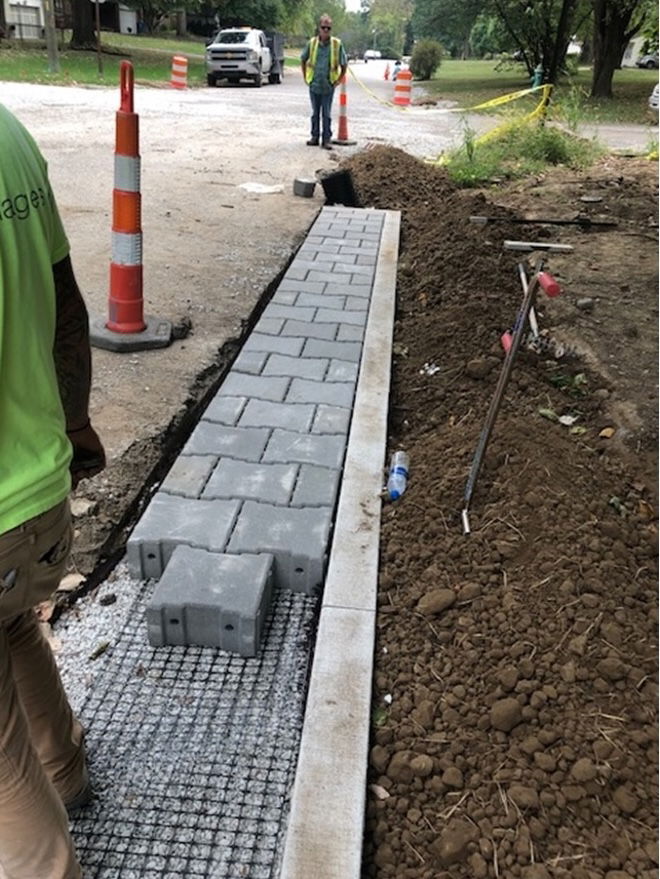
Stormwater treatment in the United States faces significant challenges, most notably increased development, rising pollution and a lack of funding to address the issues. This was demonstrated in the American Sociey for Civil Engineers (ASCE) 2021 “Infrastructure Report Card” in which the Stormwater Sector received a “D” rating with more than 600,000 miles of impaired rivers and streams as well as more than 13 million acres of impaired lakes and ponds. In addition, a 2022 Water Environment Federa...

Engineered Solutions: Record-Setting Mass Timber Building Stands Tall After Dramatic Shake Table Quake
Download the Engineered Solution
GIS Solutions: SRF Consulting Saves Lives with Innovative GIS Transportation Solutions
Download the Engineered Solution
Stormwater Interview with Robert Page, P.E., Vice President, HNTB
TriMet’s Banfield Type 1 Substation Replacement Project
February Issue 2026